Author: Julie Dunlap

  • Estate Planning: Protecting What Matters Most When Life Changes

    Estate Planning: Protecting What Matters Most When Life Changes

    Life has a way of moving faster than we expect.

    One day you’re dropping the kids off for their first day of school, the next you’re planning holiday gatherings, and before you know it, there’s a new family member to welcome home. These milestone moments—joyful as they are—serve as gentle reminders that our families and our responsibilities are constantly evolving.

    Yet despite these changes, many families continue to put off one of the most important conversations they’ll ever have: estate planning.

    Busting the Estate Planning Myths

    Let’s address the elephant in the room. When most people hear “estate planning,” they immediately think it’s not for them. Here are the most common misconceptions we encounter:

    “I’m too young to worry about estate planning.” This might be the most dangerous myth of all. Estate planning isn’t about age—it’s about responsibility. If you have people who depend on you, property you want to protect, or simply preferences about your medical care, you need a plan.

    “I don’t have enough assets to need estate planning.” Estate planning isn’t just about distributing wealth. It’s about ensuring your children are cared for by the people you choose, that your medical wishes are respected, and that someone you trust can handle your affairs if you can’t.

    “Estate planning is too complicated and expensive.” While estate planning does require some investment of time and money, the cost of not having a plan far exceeds the cost of creating one. Basic estate planning documents can be straightforward and affordable, especially compared to the legal battles and family conflicts that arise without them.

    “My family knows what I want.” Even the closest families can have different interpretations of what someone “would have wanted.” Without clear, legally binding documents, courts make decisions based on state law, not your preferences or your family’s understanding of your wishes.

    When Life Changes Call for Estate Planning Action

    Major life transitions are natural checkpoints for reviewing your estate plan. Here’s why these moments matter:

    Back-to-School Season

    Watching your children grow and gain independence is bittersweet. Each new school year brings new activities, new challenges, and new awareness of how quickly they’re maturing. This is the perfect time to ask: If something happened to me today, who would care for them? Are my guardianship designations current? Do the people I’ve chosen know about their potential responsibilities?

    Holiday Gatherings

    Holiday family time often brings perspective about what truly matters. Conversations around the dinner table, watching grandparents with grandchildren, seeing family dynamics play out—these moments highlight the importance of ensuring your family’s continued security and harmony. It’s also when many families first have serious conversations about aging parents and their needs.

    New Family Members

    Whether it’s a new baby, an adoption, a marriage, or even a divorce, changes in your family structure require updates to your estate plan. New children need to be included in wills, new spouses may need different provisions, and former spouses typically need to be removed from important documents.

    Career Changes or Financial Milestones

    Got a promotion? Started a business? Bought a house? Received an inheritance? These changes often mean your assets and income have shifted significantly, requiring updates to beneficiary designations, insurance coverage, and distribution plans.

    The Story That Changed Everything

    Let me tell you about Sarah, a 34-year-old marketing director and mother of two young children. Like many busy parents, Sarah always intended to get her estate planning done “when things slowed down.” She had a demanding career, active kids involved in multiple sports, and a household that seemed to run on perpetual motion.

    Sarah’s wake-up call came during a routine doctor’s appointment when some concerning test results required immediate follow-up. Suddenly, the “someday” conversation about estate planning became urgent. While waiting for additional test results (which thankfully came back clear), Sarah realized how unprepared her family would be if something happened to her.

    Her children’s father lived across the country and wasn’t actively involved in their daily care. Without proper documentation, her children could potentially be placed with him by default, uprooting them from their community, school, and extended family support system. Her mother, who had been helping with childcare, would have no legal authority to make decisions for the children. Her retirement accounts and life insurance still listed her ex-husband as the primary beneficiary from before their divorce.

    The two weeks Sarah spent waiting for test results were filled with anxiety—not just about her health, but about her family’s future. It was a powerful reminder that proper planning isn’t about being pessimistic; it’s about being responsible.

    After her health scare, Sarah worked with an attorney to create a comprehensive estate plan. The peace of mind she gained was immediate and profound. She could focus on her family and career knowing that if the unexpected happened, her wishes would be honored and her children would be protected.

    Essential Documents Every Family Needs

    Estate planning involves several key documents, each serving a specific purpose in protecting you and your family:

    Last Will and Testament

    Your will is the foundation of your estate plan. It specifies how your assets should be distributed after your death and, critically for parents, names guardians for minor children. Without a will, state law determines both asset distribution and guardianship decisions—and those defaults may not align with your preferences.

    A will should address:

    • Distribution of personal property and financial assets
    • Guardianship of minor children
    • Appointment of an executor to manage your estate
    • Specific bequests or charitable donations
    • Care instructions for pets

    Financial Power of Attorney

    This document authorizes someone you trust to handle financial matters on your behalf if you become unable to do so. This might include paying bills, managing investments, filing taxes, or making business decisions. Without this document, your family may need to go to court to gain authority to manage your affairs—a process that can be time-consuming and expensive.

    Healthcare Power of Attorney

    Also known as a healthcare proxy, this document designates someone to make medical decisions for you if you’re unable to communicate your wishes. This person should understand your values and be willing to advocate for your preferences, even in difficult situations.

    Advance Healthcare Directive (Living Will)

    While a healthcare power of attorney names who can make decisions, an advance directive specifies what decisions you want made. This document outlines your preferences for end-of-life care, life-sustaining treatments, and other medical interventions.

    HIPAA Authorization

    Healthcare privacy laws can prevent even close family members from accessing your medical information. A HIPAA authorization allows designated people to communicate with your healthcare providers and access medical records when necessary.

    Guardianship Designations

    For parents, this is often the most important and emotionally challenging part of estate planning. You need to designate who would care for your minor children if something happened to both parents. Consider naming both primary and backup guardians, and make sure these people are aware of your decision and willing to accept the responsibility.

    Trust Considerations

    While not every family needs a trust, they can provide significant benefits for asset protection, tax planning, and ensuring minor children’s inheritances are managed responsibly. Common types include:

    • Revocable living trusts: Help avoid probate and maintain privacy
    • Testamentary trusts: Created through your will to manage inheritances for minor children
    • Special needs trusts: Protect disabled beneficiaries’ government benefits
    • Life insurance trusts: Minimize estate tax liability on insurance proceeds

    The Hidden Costs of Procrastination

    Delaying estate planning doesn’t just create uncertainty—it can have serious financial and emotional consequences for your family:

    Court Intervention

    Without proper documents, courts must step in to make decisions about your care, your children’s guardianship, and your asset distribution. This process, called probate or guardianship proceedings, can take months or even years, during which your family may face significant uncertainty and expense.

    Family Conflicts

    When wishes aren’t clearly documented, family members may have different ideas about what you would have wanted. These disagreements can tear families apart and result in expensive legal battles that consume the very assets you wanted to protect.

    Financial Hardship

    If no one has the authority to access your accounts or manage your business, your family could face immediate financial difficulties. Bills go unpaid, business relationships suffer, and income streams may be interrupted precisely when your family needs financial stability most.

    Tax Consequences

    Poor or absent estate planning can result in unnecessary tax liability, reducing the legacy you leave to your loved ones. Proper planning can often minimize these taxes significantly.

    Lost Opportunities

    Certain estate planning strategies become unavailable once you become incapacitated or pass away. Delaying planning means potentially missing opportunities to protect assets, minimize taxes, or provide for family members in the most effective way.

    The Peace of Mind Factor

    Families who complete their estate planning consistently report an overwhelming sense of relief. There’s something profoundly comforting about knowing that no matter what life brings, you’ve taken steps to protect the people you love most.

    Consider the Martinez family, who completed their estate planning just before their youngest daughter started college. Six months later, both parents were involved in a serious car accident. While they both recovered fully, having their documents in place meant their adult children could immediately step in to handle financial matters and communicate with medical providers. What could have been a bureaucratic nightmare became a manageable situation because the family had planned ahead.

    Or think about David, a single father who worked with an attorney to create a comprehensive plan after his divorce. When his ex-wife challenged his guardianship designations, David’s detailed documentation and clear legal language protected his wishes and ensured his children would be cared for by the people he had chosen.

    These families didn’t have estate plans because they expected tragedy—they had them because they understood that protection and peace of mind are gifts you give your family.

    Getting Started: Your Estate Planning Assessment

    Ready to take action? Start by honestly assessing your current situation:

    Family Structure Questions:

    • Who are your dependents, and what are their needs?
    • Who would you want to care for minor children?
    • Are there family members with special needs requiring additional planning?
    • Have there been recent changes in your family structure?

    Financial Questions:

    • What assets do you own (home, retirement accounts, life insurance, business interests)?
    • Who are the current beneficiaries on your accounts and policies?
    • Do you have significant debts that could impact your estate?
    • Are there tax planning opportunities you should consider?

    Healthcare Questions:

    • Who would you trust to make medical decisions for you?
    • What are your preferences for end-of-life care?
    • Do you have strong feelings about certain medical treatments?

    Current Document Questions:

    • Do you have any existing estate planning documents?
    • When were they last updated?
    • Do they reflect your current wishes and circumstances?
    • Are they legally valid in your current state of residence?

    Taking the Next Step

    Estate planning is ultimately an act of love—a way of ensuring that your family is cared for and your wishes are honored. While the process requires some time and investment, the peace of mind and protection it provides are invaluable.

    If you don’t currently have estate planning documents, or if it’s been several years since you reviewed them, don’t wait for a health scare or family crisis to take action. Life’s transitions—whether it’s a child starting school, holiday family gatherings, or welcoming a new family member—are perfect reminders to prioritize this important task.

    Remember, estate planning isn’t a one-time event. Your plan should evolve as your life changes. Regular reviews ensure that your documents continue to reflect your current wishes and circumstances.

    The most important step is the first one: deciding that your family’s security and peace of mind are worth the investment of time and resources required to create a proper estate plan. Your future self—and your family—will thank you for taking action today.

    Working with experienced legal counsel ensures that your plan is comprehensive, legally sound, and tailored to your family’s unique needs. Because when it comes to protecting what matters most, you deserve nothing less than the confidence that comes from knowing your legacy is secure.


  • Q4 Business Readiness: Contract Protection and DTPA Compliance for Texas Small Businesses

    Q4 Business Readiness: Contract Protection and DTPA Compliance for Texas Small Businesses

    As we approach the final quarter of 2025, Texas small business owners are witnessing an unprecedented expansion in commercial litigation opportunities. Recent developments in Texas business law, including the expansion of the Texas Business Court’s jurisdiction and legislative changes that dramatically broadened the court’s authority, underscore the growing importance of proper contract management. The Business Court’s amount-in-controversy threshold has been reduced from $10 million to $5 million for most cases, meaning more business disputes now qualify for specialized court proceedings.

    This evolving legal landscape makes Q4 contract review and compliance more critical than ever. Recent contract dispute trends show that disagreements over project timelines, quality of work, non-payment, and breach of confidentiality clauses continue to dominate business litigation.

    The Real Cost of Unclear Agreements

    The numbers tell a sobering story: Texas courts must handle breach of contract claims within a four-year statute of limitations, and parties can agree to shorter limitations periods, but not less than two years. When contracts fail, the financial stakes are significant. Texas law provides various remedies including actual damages, consequential damages, and in rare cases, exemplary damages, with attorney fees recoverable if provided for in the contract.

    Consider these real-world implications for small businesses:

    • Delayed Discovery Issues: Under the Texas Deceptive Trade Practices Act (DTPA), the two-year statute of limitations starts from when the violation occurred or when the consumer discovered or should have discovered the violation
    • Aggregated Claims: Related business transactions can now be aggregated to meet the $5 million threshold for Texas Business Court jurisdiction
    • Professional Service Exemptions: Attorneys and real estate professionals have limited exemptions from DTPA claims, but these don’t apply in cases of fraud or misrepresentation

    Understanding Texas Contract Law and DTPA Exposure

    When Professional Contracts Become DTPA Claims

    Many small business owners don’t realize that their standard service agreements can trigger DTPA liability. The DTPA is a broad consumer protection law that allows individuals to sue anyone who makes false, misleading, or deceptive statements in the course of business. This includes partnerships and corporations, not just individual actors.

    Critical DTPA Trigger Points for Small Businesses:

    1. Misrepresentation of Services: Section 17.46 of the Texas Business and Commerce Code bans a broad array of acts, including passing off goods or services as another’s and misrepresenting characteristics or benefits
    2. Failure to Disclose: It is a violation of the DTPA to not disclose known defects if the reason for failing to disclose was to lure the consumer into the transaction
    3. Unconscionable Actions: The DTPA protects against any act that would be considered unconscionable, defined as taking advantage of a person’s lack of knowledge to a grossly unfair degree

    The Triple Damage Risk

    The DTPA’s enforcement mechanism is particularly harsh for small businesses. Consumers might be entitled to seek triple their amount of actual damages under the DTPA if they can prove intentional deception. Even more concerning, intent to deceive is irrelevant to DTPA liability—defendants are often surprised to learn that good intent is not a defense.

    Common Contract Pitfalls That Lead to Litigation

    Scope of Work Ambiguities

    Many small business contracts fail because they don’t clearly define deliverables, timelines, or quality standards. When disputes arise, issues like non-payment or breach of confidentiality can arise, and employment contracts often see disputes over termination or non-compete clauses.

    Example: A marketing consultant contracts to “increase website traffic” without defining specific metrics, timeframes, or baseline measurements. When the client claims insufficient results, the vague language creates grounds for both breach of contract and potential DTPA claims.

    Payment and Milestone Problems

    A mere breach of contract without more does not constitute a false, misleading or deceptive act in violation of the DTPA. There has to be more than just a breach of the agreement. However, problems arise when:

    • Payment terms are unclear or contradictory
    • Milestone definitions lack objective criteria
    • Change order procedures aren’t properly documented

    Vendor and Client Relationship Risks

    Small businesses often overlook the bidirectional nature of DTPA exposure. The DTPA provides that a consumer may bring suit against any person whose false, misleading, or deceptive acts are a producing cause of harm, with “person” defined as an individual, partnership, corporation, association, or other group.

    This means your business could face DTPA claims from:

    • Clients who feel misled about service capabilities
    • Vendors claiming deceptive practices in procurement
    • Partners alleging misrepresentation in joint ventures

    Q4 Contract Review Essentials

    The 60-Day Notice Requirement

    One critical protection mechanism requires advance planning. The DTPA requires that you give written notice to the merchant or seller at least 60 days before filing suit in court, and this notice must include economic damages sought and attorney’s fees.

    Action Item: Review all client agreements to ensure they include proper dispute resolution procedures that comply with DTPA notice requirements.

    Key Contract Provisions to Update

    1. Clear Performance Standards

    • Define all deliverables with objective, measurable criteria
    • Include specific timelines with built-in flexibility for unforeseen circumstances
    • Document approval processes and change order procedures

    2. DTPA-Compliant Disclosures

    • Include limitations on services or products upfront
    • Disclose any known risks or potential issues
    • Avoid overstating capabilities or guaranteed outcomes

    3. Dispute Resolution Clauses

    • Consider arbitration clauses for faster, more private resolution
    • Include Texas venue selection (potentially the Texas Business Court for eligible disputes)
    • Address attorney fee recovery provisions

    4. Termination and Remedies

    • Specify available remedies including actual damages, consequential damages, and attorney fees
    • Include cure periods for material breaches
    • Address intellectual property and confidentiality upon termination

    Protecting Your Business Before Year-End

    Documentation and Record Keeping

    Proper documentation is essential for contract disputes, including preserving crucial evidence, reviewing contract terms, and identifying any applicable tolling provisions. Establish systems for:

    • Email correspondence relating to contract performance
    • Project milestone completions and approvals
    • Change orders and scope modifications
    • Payment records and invoicing history

    Vendor Agreement Updates

    Review all vendor contracts for:

    • Clear payment terms and dispute resolution procedures
    • Proper insurance and indemnification clauses
    • Compliance with new Texas business regulations
    • DTPA exposure minimization

    Client Contract Standardization

    Ensure consistency across all client agreements:

    • Standardized terms and conditions
    • Clear scope limitations and exclusions
    • Proper notice and communication procedures
    • Regular update cycles to reflect legal changes

    The Benefits of Proactive Legal Review

    Risk Mitigation

    Professional legal review of your contracts serves multiple protective functions:

    Immediate Protection: Identifies current exposure areas and compliance gaps before they become disputes.

    Long-term Strategy: With the Texas Business Court’s expanded jurisdiction now covering intellectual property disputes, business torts, and complex commercial contracts, having properly drafted agreements ensures access to specialized judicial expertise.

    Cost Management: Early intervention through proper contract drafting is significantly more cost-effective than litigation, which can be time-consuming and costly.

    Competitive Advantages

    Well-drafted contracts provide business advantages beyond legal protection:

    • Faster dispute resolution through clear procedures
    • Enhanced client confidence through transparent agreements
    • Reduced administrative overhead from fewer contract clarifications
    • Professional reputation enhancement through consistent, fair dealing

    How The Woodlands Law Firm Protects Your Business Interests

    Comprehensive Contract Review Services

    Our approach to Q4 contract preparation includes:

    Current Contract Audit: We review existing agreements for DTPA compliance, enforceability issues, and gap analysis against current Texas law changes.

    Industry-Specific Customization: With the Texas Business Court now expressly covering intellectual property disputes, trade secrets, software, data security, and biotechnology cases, we ensure your contracts are properly positioned for specialized court proceedings when necessary.

    Ongoing Compliance Monitoring: Regular updates to reflect evolving Texas business law and regulatory changes.

    Litigation Prevention Strategies

    Our preventive approach includes:

    • DTPA exposure analysis and mitigation strategies
    • Dispute resolution procedure optimization
    • Vendor and client agreement standardization
    • Emergency contract issue resolution

    When Disputes Arise

    Despite best efforts, contract disputes sometimes occur. Our litigation team provides:

    • Immediate case evaluation and strategy development
    • Negotiation, mediation, and arbitration services to resolve disputes without lengthy court proceedings
    • Full litigation support in state and federal courts
    • Specialized Texas Business Court representation for qualifying cases

    Taking Action Before 2026

    The fourth quarter presents an ideal opportunity to strengthen your business foundation through proper contract management. Recent changes to Texas business law create both opportunities and risks that require proactive attention.

    Immediate Steps for Q4:

    1. Schedule a contract audit to identify current exposure areas
    2. Update standard agreements to reflect current Texas law requirements
    3. Implement documentation systems for better dispute prevention
    4. Train staff on proper contract administration and communication procedures

    Long-term Business Protection:

    The investment in proper contract review and legal guidance provides returns that extend well beyond immediate compliance. With Texas positioning itself as the go-to forum for complex business disputes through its expanded Business Court system, having professionally drafted agreements ensures your business is positioned for success in 2026 and beyond.

    Don’t let unclear contracts become costly litigation. Contact The Woodlands Law Firm today to schedule your Q4 contract review and ensure your business enters the new year with comprehensive legal protection.


    The information provided in this blog post is for educational purposes only and does not constitute legal advice. Each business situation is unique and requires individualized legal analysis. Contact The Woodlands Law Firm for specific guidance on your contract and DTPA compliance needs.

  • When School Insurance Falls Short: Understanding Your Personal Injury Rights in Texas

    When School Insurance Falls Short: Understanding Your Personal Injury Rights in Texas

    When 13-year-old Sarah fell from the monkey bars during recess, her parents thought they had everything covered. They had excellent health insurance through their employer, the school had always seemed safe, and they’d never worried about who would pay if something went wrong. Three months and $47,000 in medical bills later, they discovered a harsh reality: their insurance had significant gaps, the school claimed immunity from any responsibility, and their daughter’s long-term medical needs far exceeded what any insurance would cover.

    Sarah’s story isn’t unique. Upwards of 40,000 kids are injured each year in gym class alone, and countless more are hurt during regular school activities, sports, and transportation. Yet most parents remain dangerously unaware of their legal rights when their child is seriously injured at school—often discovering too late that insurance coverage, even when it exists, rarely provides full compensation for the true costs of a significant injury.

    Beyond Insurance: When Personal Injury Claims Become Necessary

    While insurance may cover basic medical expenses, it rarely addresses the full scope of damages families face after a serious school-related injury. Personal injury claims can provide compensation for losses that no insurance policy will cover, including:

    Long-term Medical Care: When injuries require ongoing therapy, specialized equipment, or future surgeries that exceed insurance policy limits.

    Pain and Suffering: The physical and emotional trauma your child endures has real value that insurance companies don’t compensate.

    Lost Future Earnings: If injuries result in permanent disabilities affecting your child’s future earning capacity.

    Educational Support: Special tutoring, modified learning environments, or educational accommodations not covered by standard insurance.

    Family Impact: Lost wages from parents who must leave work to care for their injured child, which insurance typically doesn’t address.

    The critical question isn’t just “Will insurance pay?”—it’s “Who is legally responsible for the full extent of my child’s damages?”

    When Personal Injury Claims Against Schools Are Possible in Texas

    Under the Texas Tort Claims Act, you may be able to pursue a personal injury claim against a school district in these specific situations:

    Motor Vehicle-Related Injuries: The most common exception involves school buses, maintenance vehicles, or other motor vehicles operated by school employees. If your child is injured in a school bus accident, during transportation to field trips, or by district vehicles on school property, the school district may be held liable for the full extent of damages.

    Excessive Force by School Personnel: If school employees use excessive force while disciplining students, resulting in bodily injury, personal injury claims may be possible. This includes cases involving inappropriate restraint techniques, unreasonable physical discipline, or aggressive handling of students.

    Third-Party Liability: Even when the school district has immunity, other parties may be liable for your child’s injuries:

    • Equipment manufacturers (defective playground equipment, sports gear)
    • Private contractors working on school property
    • Other students and their families (for intentional acts)
    • Private transportation companies
    • Event venues during field trips

    The Insurance Coverage Reality Check

    Understanding available insurance is crucial because it directly impacts the value and strategy of personal injury claims.

    Health Insurance Limitations in Personal Injury Cases: Your family’s health insurance covers basic medical treatment but creates significant gaps that personal injury claims must address:

    • Out-of-Pocket Maximums: Even excellent insurance can leave families with $10,000+ in annual out-of-pocket costs
    • Network Restrictions: Emergency treatment at out-of-network facilities can result in substantial additional costs
    • Future Medical Needs: Insurance doesn’t guarantee coverage for future treatments your child may need
    • Non-Medical Losses: No coverage for pain and suffering, lost educational opportunities, or family financial impact

    School District Insurance: Most districts carry liability insurance, but remember that Texas school districts have damage caps of only $100,000 per person and $300,000 per occurrence. For serious injuries, these limits are often inadequate to cover the true costs of medical care, rehabilitation, and long-term needs.

    Homeowners Insurance in Personal Injury Cases: This becomes relevant in two key scenarios:

    • When your child injures another student (your liability coverage protects your family)
    • When another student injures your child (the other family’s homeowners policy may provide additional recovery beyond school district limits)

    Understanding Texas School Liability: When You Can Pursue Personal Injury Claims

    The unfortunate reality is that Texas provides some of the strongest legal protections for schools in the nation, making personal injury claims extremely challenging—but not impossible in specific circumstances.

    The Texas Sovereign Immunity Reality

    In Texas, public schools are virtually bulletproof from most lawsuits due to the doctrine of sovereign immunity, making Texas schools among the most protected in the nation. Under the Texas Tort Claims Act, a school district or a school employee can only be liable for injuries to a child if that injury arises out of the operation or use of a motor vehicle, or in very narrow circumstances involving excessive punishment of a student.

    This means that if a shop student loses several fingers because the electric saw didn’t have a proper guard, if a student is injured on poorly maintained playground equipment, or if a student is hurt due to improperly maintained floors or bleachers, the school has no legal responsibility for the child’s injuries or medical expenses under Texas law.

    Limited Exceptions to Texas School Immunity

    Section 101.021 of the Texas Civil Practice and Remedies Code provides that a school district may be held liable for personal injuries or wrongful death if the injuries resulted from the negligent operation of a motor vehicle by an employee acting in the course and scope of their employment. Additionally, professional school employees can be held liable for excessive force in student discipline or negligence resulting in bodily injury to students.

    Maximizing Recovery: Why Personal Injury Claims Matter

    Even when insurance provides some coverage, personal injury claims serve crucial purposes that insurance cannot address:

    Full Compensation for All Damages

    Insurance payments are limited by policy terms and often don’t reflect the true value of your child’s injuries. Personal injury claims can recover:

    • Past and Future Medical Expenses: Beyond what insurance covers
    • Pain and Suffering: Compensation for physical and emotional trauma
    • Lost Earning Capacity: If injuries affect your child’s future opportunities
    • Educational Costs: Special tutoring, modified programs, assistive technology
    • Family Economic Impact: Lost wages, travel expenses, home modifications
    • Rehabilitation Costs: Physical therapy, occupational therapy, counseling

    Holding Responsible Parties Accountable

    Personal injury claims serve an important function beyond compensation—they hold negligent parties accountable and can drive systemic changes that prevent future injuries to other children.

    Securing Your Child’s Future

    Insurance settlements are typically one-time payments that may seem adequate initially but prove insufficient as your child grows and their needs evolve. Personal injury claims can establish structured settlements or judgments that provide long-term financial security.

    Building Strong Personal Injury Cases in School-Related Incidents

    Successful personal injury claims require immediate action and strategic approach:

    Immediate Evidence Preservation

    Document Everything: Photograph the accident scene, equipment involved, and your child’s injuries. Obtain incident reports from school officials and preserve all medical records.

    Witness Statements: Collect contact information from anyone who witnessed the incident, including other students, teachers, and staff.

    Preserve Physical Evidence: If defective equipment was involved, ensure it’s preserved. Take photos of playground equipment, classroom conditions, or vehicle damage.

    Understanding Liability Beyond the School District

    Even with Texas’s strong school immunity laws, multiple parties may be liable:

    Product Manufacturers: Defective playground equipment, sports equipment, or vehicles may create product liability claims against manufacturers.

    Private Contractors: Companies hired for construction, maintenance, or transportation may not enjoy governmental immunity.

    Individual Employees: In cases involving excessive force or intentional misconduct, individual school employees may be personally liable.

    Other Families: When another student causes injury through intentional acts, their family’s homeowners insurance may provide significant recovery options.

    When to Pursue Personal Injury Claims: Key Indicators

    Consider consulting with a personal injury attorney immediately if your child’s case involves:

    High-Value Injury Indicators

    Permanent Disabilities: Injuries affecting your child’s long-term physical or cognitive abilities Traumatic Brain Injuries: Even “mild” concussions can have lasting effects requiring ongoing care Spinal Injuries: Any injury to the back or neck that could affect mobility or sensation Multiple Surgeries: Injuries requiring complex medical interventions and lengthy recovery Scarring or Disfigurement: Permanent physical changes that may affect your child’s future

    Liability Scenarios Worth Investigating

    Motor Vehicle Incidents: School bus accidents, being struck by district vehicles, or transportation-related injuries Equipment Failures: Injuries from defective playground equipment, sports gear, or classroom tools Supervision Failures: Injuries occurring when adequate supervision could have prevented the incident Excessive Discipline: Any injury resulting from inappropriate physical handling by school personnel Premises Hazards: Injuries from dangerous conditions on school property that should have been addressed

    What to Do When an Injury Occurs

    Immediate Steps

    Seek Medical Attention First: Your child’s health is the priority. Get appropriate medical care regardless of insurance coverage concerns.

    Document the Incident: Laws vary from state to state, but in most cases, schools in the United States have a legal obligation to notify parents or guardians when a child is injured while at school. Ensure you receive a written incident report and keep detailed records of all communications.

    Notify All Insurance Carriers: Contact your health insurance, the school district’s insurance administrator, and your homeowners insurance carrier to report the incident and understand coverage.

    Navigating the Claims Process

    Understanding the Pecking Order: If a student is injured, he or she would first get the medical treatment they need, and the medical provider would bill the primary insurance. The school and family would then work together to complete the accident claim form which needs to get submitted to the student accident insurance administrator.

    Keep Detailed Records: Maintain files of all medical bills, insurance correspondence, and out-of-pocket expenses. These records become crucial if you need to pursue additional compensation through legal channels.

    When Insurance Isn’t Enough: Legal Options

    Recognizing When You Need Legal Help

    If your child’s injuries resulted from negligence—whether by the school, another student, or a third party—insurance coverage may not fully compensate for your family’s losses. You should consider consulting with a personal injury attorney when:

    • Medical expenses exceed insurance coverage limits
    • Your child faces long-term disabilities requiring ongoing care
    • The school failed to provide adequate supervision or maintain safe conditions
    • Another party’s negligence contributed to the injury
    • Insurance companies are denying valid claims or offering inadequate settlements

    Texas Damage Limitations

    Even if you successfully pursue a claim against a Texas school district, the Texas Tort Claims Act places strict caps on recoverable damages. For school districts (considered units of local government), damages are limited to:

    • $100,000 per person for bodily injury
    • $300,000 per occurrence for all claimants combined
    • $100,000 per occurrence for property damage

    These caps apply regardless of the severity of the injury and can be a significant barrier to full recovery, particularly in cases involving catastrophic injuries or long-term medical needs.

    Texas-Specific Time Requirements: Under the Texas Tort Claims Act, you must provide written notice of your claim to the school district within six months of the incident. The notice must reasonably describe the alleged injury, the time and place of the incident, and the incident itself. After providing notice, you have two years from the date of injury to file a lawsuit. These deadlines are strictly enforced, making early legal consultation crucial.

    Insurance Decision-Making Checklist

    Before the School Year Starts:

    • [ ] Review all current insurance policies for coverage limits and exclusions
    • [ ] Contact your school district to understand available student accident insurance
    • [ ] Consider purchasing additional coverage if gaps exist in your current policies
    • [ ] Update emergency contact information at school and with all insurance carriers
    • [ ] Understand Texas notice requirements – You have only six months to notify school districts of potential claims
    • [ ] Document the incident immediately – Texas law requires detailed notice within strict timeframes
    • [ ] Know the limited circumstances where Texas school districts can be held liable (motor vehicle operation, excessive discipline)

    For High-Risk Activities:

    • [ ] Understand specific coverage for sports and extracurricular activities
    • [ ] Review activity waivers carefully before signing—they may limit your legal options
    • [ ] Consider supplemental insurance for high-risk activities not fully covered
    • [ ] Ensure you have copies of all signed waivers and insurance documents

    Financial Protection Strategies:

    • [ ] Establish an emergency fund for potential out-of-pocket medical expenses
    • [ ] Consider increasing homeowners liability limits to protect against claims
    • [ ] Understand your employer’s benefits regarding family leave for medical emergencies
    • [ ] Review flexible spending account options for predictable medical expenses

    Don’t Let Insurance Gaps Destroy Your Family’s Future

    The unfortunate reality is that most families discover their insurance coverage gaps at the worst possible moment—when their injured child needs immediate care and they’re facing mounting bills they never anticipated. By understanding these complexities before an emergency strikes, you can make informed decisions that protect both your child’s health and your family’s financial stability.

    Remember: insurance companies are businesses designed to minimize payouts, not maximize your family’s recovery. When facing serious injuries with long-term consequences, having an experienced advocate who understands both insurance law and personal injury claims can make the difference between adequate compensation and financial hardship.


    Your Family Deserves Full Protection

    If your child has been injured at school and you’re facing insurance coverage disputes, mounting medical bills, or questions about your legal rights, don’t navigate this complex system alone. The decisions you make in the days and weeks following your child’s injury can significantly impact your family’s financial future and your child’s access to necessary care.

    Professional Legal Consultation

    Our experienced personal injury attorneys specialize in school-related injury cases and understand both the limitations of insurance coverage and the complex liability landscape under Texas law. We can help you:

    • Evaluate whether your case falls within the exceptions to school district immunity
    • Identify all potentially liable parties beyond the school district
    • Coordinate with insurance carriers to maximize available coverage
    • Build a strong case for full compensation of your child’s damages
    • Navigate the strict notice requirements and damage caps under Texas law

    Contact us immediately if:

    • Your child has suffered serious injuries requiring ongoing medical care
    • The incident involved school buses, district vehicles, or transportation
    • School personnel used excessive force or inappropriate discipline
    • Defective equipment or dangerous conditions contributed to the injury
    • Insurance coverage is insufficient for your child’s medical needs
    • You need to meet the six-month notice requirement under Texas law

    Don’t let Texas’s protective laws for school districts prevent you from pursuing full compensation for your child’s injuries. Even with limited school district liability, multiple sources of recovery may be available through product liability, premises liability, or third-party claims.

    Call now: Understanding your legal options is the first step toward securing your child’s future.

  • Back-to-School Safety: Protecting Students and Families on the Road

    Back-to-School Safety: Protecting Students and Families on the Road

    It was only the second week of school when a car failed to stop at a crosswalk outside Jefferson Elementary.
    A fifth-grader, hurrying to meet friends, darted into the street. Thankfully, the driver braked just in time—but it was a terrifying reminder: school zones are some of the most dangerous areas for both kids and drivers at the start of the school year.

    As the bell rings and backpacks hit the sidewalks, traffic congestion spikes, drop-off lines overflow, and distracted driving increases. Every year, news headlines remind us how quickly a normal school day can turn into a preventable tragedy.


    Understanding the Risks Around School Zones

    The first weeks of school bring:

    • Heavier pedestrian traffic with children walking or biking.
    • Distracted drivers juggling work schedules, morning coffee, and GPS directions.
    • Confusing drop-off routines that lead to unsafe U-turns or double parking.

    The National Highway Traffic Safety Administration (NHTSA) reports that most school-age pedestrian fatalities occur in the hours right before and after school.


    Legal Responsibilities for Parents and Drivers

    Both parents and drivers play crucial roles in keeping students safe:

    Drivers Must:

    • Obey posted school-zone speed limits.
    • Stop fully at crosswalks and bus loading zones.
    • Avoid distracted driving (texting in school zones is often illegal).

    Parents Must:

    • Teach children to use crosswalks and follow crossing guards.
    • Avoid unsafe drop-offs, like letting kids exit on the street side.
    • Ensure young cyclists wear helmets and know traffic rules.

    Failure to follow these responsibilities can lead to serious liability if an accident occurs.


    Actionable Tips to Prevent Accidents

    • Plan drop-offs to avoid rushing—leave 10–15 minutes early.
    • Walk the route with young kids to teach safe crossing habits.
    • Use school-approved drop-off zones to reduce traffic chaos.
    • Remind teen drivers about school-zone rules and distracted driving penalties.

    What to Do if an Accident Happens

    Even with precautions, accidents can occur. Here’s what families should do:

    1. Seek immediate medical attention for anyone injured.
    2. Call the police to create an official accident report.
    3. Document the scene with photos, videos, and witness names.
    4. Notify your insurance and provide all documentation promptly.

    Insurance Claims:

    • Student Injuries: May involve the driver’s auto policy, the school’s liability coverage, or the family’s own health insurance.
    • Vehicle Damages: Typically handled through the at-fault driver’s auto insurance.

    How Personal Injury Counsel Helps

    An experienced personal injury attorney can:

    • Investigate liability and gather evidence.
    • Negotiate with insurers for full medical and property coverage.
    • Protect families from being pressured into low settlements.

    Even minor accidents can involve complex insurance questions, and legal guidance ensures families are treated fairly.


    Quick-Reference Safety Checklist for Parents

    ✅ Walk your child’s route to school and identify safe crossings.
    ✅ Teach them to make eye contact with drivers before crossing.
    ✅ Review bus stop safety and never chase a moving bus.
    ✅ Check bikes and helmets for proper fit and visibility.
    ✅ Save the school and local non-emergency numbers in your phone.


    If your family experiences a school-zone accident, don’t face the insurance process alone. Our team can help you understand your rights, protect your child, and pursue fair compensation.

    📞 Contact us today for a consultation to ensure your family is fully protected.

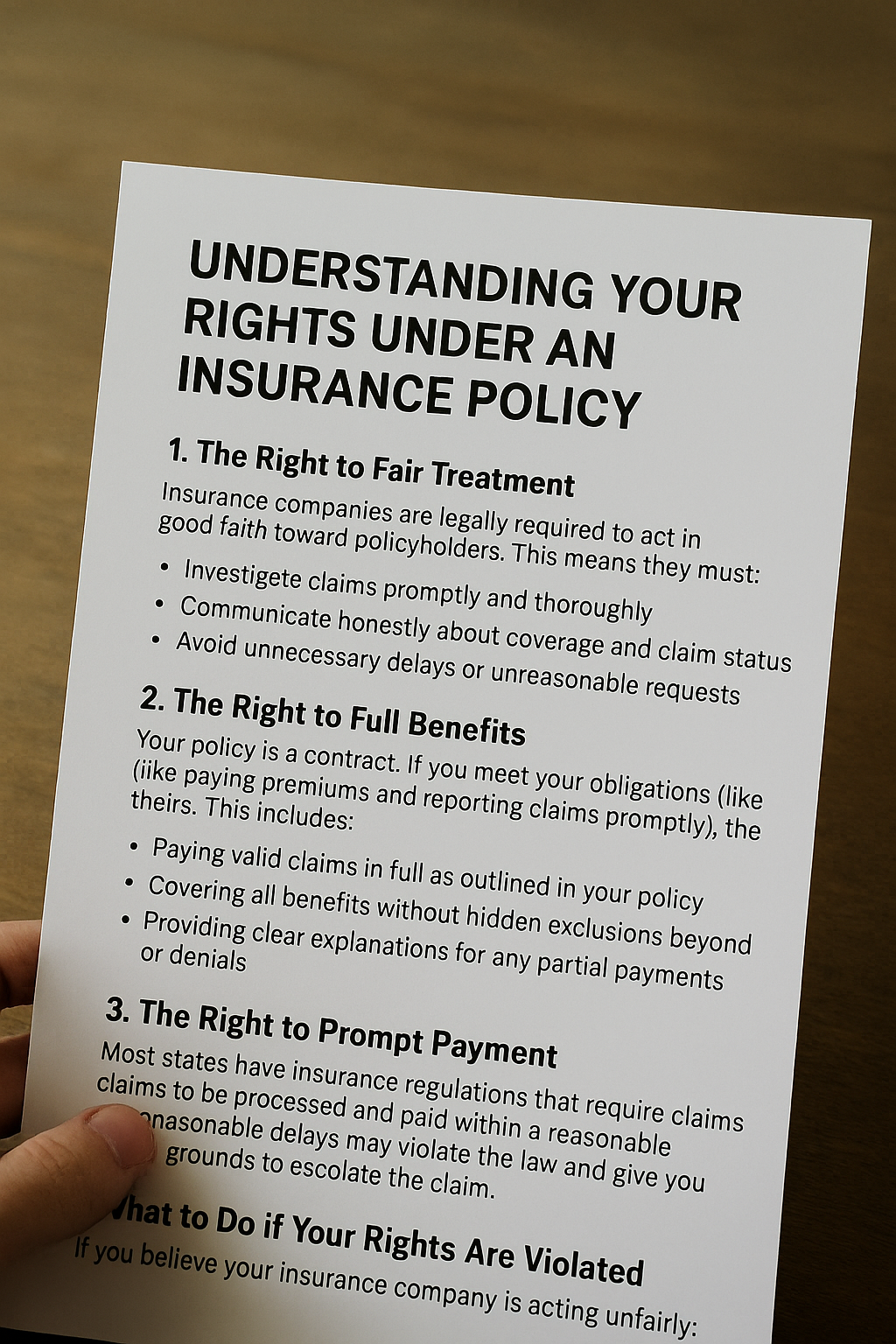
  • Understanding Your Rights Under an Insurance Policy

    Understanding Your Rights Under an Insurance Policy

    Insurance is meant to provide peace of mind. Whether it’s for your car, home, health, or life, a policy is a promise that if something goes wrong, your insurer will step in. But many policyholders don’t realize they have specific legal rights when it comes to filing a claim. Knowing these rights can protect you from delays, lowball offers, or unfair treatment.


    1. The Right to Fair Treatment

    Insurance companies are legally required to act in good faith toward their policyholders. This means they must:

    • Investigate claims promptly and thoroughly
    • Communicate honestly about coverage and claim status
    • Avoid unnecessary delays or unreasonable requests

    If an insurer deliberately stalls or denies your claim without cause, that could be considered bad faith insurance practices.


    2. The Right to Full Benefits

    Your policy is a contract. If you meet your obligations (like paying premiums and reporting claims promptly), the insurer must honor theirs. This includes:

    • Paying valid claims in full as outlined in your policy
    • Covering all benefits without hidden exclusions beyond what the policy states
    • Providing clear explanations for any partial payments or denials

    Tip: Always review your policy so you know exactly what is—and isn’t—covered.


    3. The Right to Prompt Payment

    Most states have insurance regulations that require claims to be processed and paid within a reasonable timeframe. Unreasonable delays may violate the law and give you grounds to escalate the claim.


    4. What to Do if Your Rights Are Violated

    If you believe your insurance company is acting unfairly:

    1. Document everything. Keep copies of emails, letters, and claim forms.
    2. Request written explanations. Ask for reasons behind any delay or denial.
    3. File a complaint. Contact your state’s department of insurance to report unfair practices.
    4. Seek legal help if necessary. An attorney can guide you if the insurer refuses to comply with the law.

    Bottom Line

    Understanding your rights under an insurance policy helps you hold companies accountable. A little knowledge can make the difference between a smooth claim and a frustrating battle.

  • Understanding Warranty Misrepresentations: Know Your Rights as a Consumer

    Understanding Warranty Misrepresentations: Know Your Rights as a Consumer

    When you buy a product—whether it’s a car, appliance, or tech gadget—you expect the warranty to give you peace of mind. But sometimes, businesses promise more than they actually deliver. Warranty misrepresentation happens when a company makes claims about the coverage of a warranty that are misleading or flat-out false.

    Understanding how to spot these misrepresentations can save you money, time, and frustration.


    1. What Is a Warranty Misrepresentation?

    A warranty misrepresentation occurs when a seller or manufacturer:

    • Overstates coverage (e.g., “bumper-to-bumper” coverage that excludes key components).
    • Hides limitations or small-print exclusions.
    • Suggests the warranty is longer or more comprehensive than it really is.

    For example, a store might advertise a “lifetime warranty,” but in the fine print, it only applies to the product’s “useful life,” which might be far shorter than you expect.


    2. How to Read Warranty Language Like a Pro

    Most misrepresentations become clear if you take a closer look. Key things to check:

    • Duration: How long does the warranty actually last?
    • Coverage: Which parts, services, or issues are included?
    • Exclusions: Are there any “gotchas,” like damage from normal wear and tear or improper use?
    • Requirements: Does the warranty require registration, maintenance, or using only authorized service providers?

    Pro Tip: Don’t rely on verbal promises alone. Always read the official written warranty before making a purchase.


    3. Signs a Warranty Is Being Misrepresented

    Be wary if you hear or see claims like:

    • “Everything is covered—no matter what!”
    • “This warranty lasts forever” (without clear written terms).
    • “Repairs are free” but service fees or shipping costs are hidden in the fine print.

    If the sales pitch sounds too good to be true, it probably is.


    4. What to Do If You Suspect a Misrepresentation

    If you think a company misled you about a warranty:

    1. Review the written warranty. Compare it to the advertising or verbal promises.
    2. Contact the seller or manufacturer. Sometimes, misrepresentations are mistakes that can be resolved.
    3. Keep documentation. Save receipts, ads, and emails showing the original claims.
    4. File a complaint. If the business won’t honor the warranty, you can file a complaint with the Federal Trade Commission (FTC) or your state attorney general’s office.

    Bottom Line

    Warranty misrepresentations can leave you feeling cheated, but knowing your rights and reading the fine print can protect you. Always verify coverage, keep records, and don’t hesitate to speak up if something seems off.

  • Common Reasons Insurance Claims Are Denied

    Common Reasons Insurance Claims Are Denied

    ou pay your insurance premiums expecting protection when you need it most. But all too often, policyholders face unexpected claim denials—sometimes for valid reasons, and sometimes in bad faith.

    Understanding why insurers deny claims can help you avoid common mistakes, recognize unfair practices, and strengthen your case if you need to fight back.

    Below are some of the most common reasons claims get denied—and what you can do about it.


    1️⃣ Policy Exclusions

    ✅ Most insurance policies include explicit exclusions—things they won’t cover.
    ✅ Examples:

    • Flood damage excluded from homeowners insurance
    • Intentional acts excluded from liability coverage

    Tip: Always read your policy carefully to know what’s covered and what’s not.


    2️⃣ Lapsed or Unpaid Premiums

    ✅ Missing payments can cause your policy to lapse, leaving you with no coverage when you need it.
    ✅ Insurers will often deny claims if the policy wasn’t active on the date of loss.

    Tip: Stay on top of payments and confirm your policy is in force.


    3️⃣ Misrepresentations or Errors in Your Application

    ✅ Insurers may deny claims if they discover false information or omissions on your initial application.
    ✅ Even unintentional errors can create problems.

    Tip: Be honest and thorough when applying for coverage.


    4️⃣ Claim Filing Errors or Missed Deadlines

    ✅ Insurers require you to report claims promptly and follow specific procedures.
    ✅ Missing deadlines or failing to provide requested documentation can lead to denials.

    Tip: File claims quickly and keep copies of all communications.


    5️⃣ Disputed Cause of Loss

    ✅ Insurers may claim the damage or injury wasn’t caused by a covered event.
    ✅ Example: Saying a roof collapsed from “wear and tear,” not storm damage.

    Tip: Gather evidence, photos, and expert reports to prove your claim.


    6️⃣ Policy Limits and Underinsurance

    ✅ Even valid claims can be limited by policy caps.
    ✅ Insurers will not pay more than your maximum coverage amount.

    Tip: Review your policy regularly to make sure your limits match your needs.


    7️⃣ Alleged Fraud

    ✅ Insurers may deny claims if they suspect fraud or deliberate exaggeration.
    ✅ Even minor inaccuracies can be used against you.

    Tip: Be truthful and consistent in every claim.


    8️⃣ Bad Faith Denials

    ✅ Sometimes insurers wrongfully deny valid claims to save money.
    ✅ Signs of bad faith:

    • Unreasonable delays
    • Ignoring evidence
    • Misrepresenting policy terms
    • Lowball offers

    Tip: You have legal rights. A lawyer can help challenge bad faith practices.


    📞 Denied? Don’t Give Up.

    A denial doesn’t always mean the end. Many claims can be appealed or challenged.

    At The Woodlands Law Firm, we help clients:
    ✅ Review denial letters
    ✅ Understand their policy
    ✅ Gather evidence
    ✅ Negotiate or litigate to get the benefits they deserve

    Contact us today for a consultation. Let’s make sure you’re treated fairly.

  • Recognizing Deceptive Legal Service Advertisements

    Recognizing Deceptive Legal Service Advertisements

    When you’re looking for legal help, advertisements are often the first thing you see. Billboards, online ads, TV spots, and websites all promise to help—but not all legal ads are created equal.

    Some attorneys and legal service companies use misleading or exaggerated claims to win your business. It’s critical to know how to spot red flags, verify credentials, and choose representation you can trust.

    Below we’ll explain common advertising tricks and how to protect yourself.


    1️⃣ Beware of Guaranteed Results

    Red Flag: Ads that promise you’ll “win your case” or get “millions guaranteed.”
    Reality: No ethical attorney can guarantee an outcome. Every case is different.

    Tip: Trust lawyers who give you an honest, realistic assessment—not false promises.


    2️⃣ Watch Out for “Too Good to Be True” Fees

    Some ads highlight extremely low fees or “no cost” services.

    ✅ Make sure you understand:

    • Contingency fees (a percentage of your recovery)
    • Hourly rates or flat fees
    • Costs that may be deducted from any settlement

    Tip: Always ask for a clear written fee agreement before you sign.


    3️⃣ Check Their License and Credentials

    Some companies advertise “legal help” without licensed attorneys at all.

    ✅ Verify that you’re actually hiring a licensed lawyer.
    ✅ Check with your state bar association to see if they’re in good standing.

    Tip: Legitimate attorneys will provide their bar number and credentials.


    4️⃣ Investigate Their Experience

    ✅ Don’t rely on slick marketing alone. Look for:

    • Years of experience in the relevant practice area
    • Client reviews and testimonials
    • Case results (with realistic, verifiable examples)

    Tip: Ask questions about their experience handling cases like yours.


    5️⃣ Look for Clear, Honest Communication

    ✅ Ethical attorneys explain your options and the risks—not just the upside.
    ✅ Be wary of high-pressure sales tactics or pushy staff.

    Tip: Choose a lawyer who listens, answers your questions, and treats you with respect.


    6️⃣ Remember: Not All “Legal Services” Are Law Firms

    Be cautious of:

    • Document preparation companies that aren’t law firms
    • Non-attorney services claiming to offer legal advice
    • Out-of-state companies targeting local clients without being licensed locally

    ✅ These services often can’t represent you in court or give legal advice at all.


    📞 Protect Yourself and Make Informed Choices

    At The Woodlands Law Firm, we believe clients deserve honest advice, experienced representation, and clear communication—without misleading promises.

    If you’re looking for real legal help you can trust, contact us today for a consultation. Let’s talk about your needs and how we can help.

  • What Can Happen After a Trial Ends?

    What Can Happen After a Trial Ends?

    A trial verdict feels like the finish line—but it’s often just the beginning of the next phase. After a verdict is entered, both sides still have important options and responsibilities. Whether you’ve won or lost, it’s essential to know what can happen after a trial ends and what legal steps might come next.

    Below we’ll explain post-trial motions, appeals, and enforcing judgments so you understand your rights and options.


    1️⃣ Post-Verdict Motions

    Even after the jury or judge reaches a verdict, either side may ask the court to reconsider or change the outcome. These post-trial motions must usually be filed within strict time limits.

    Motion for Judgment Notwithstanding the Verdict (JNOV):
    Asks the judge to override the jury’s decision if no reasonable jury could have reached that verdict based on the evidence.

    Motion for a New Trial:
    Seeks a complete do-over because of legal errors, jury misconduct, newly discovered evidence, or other serious problems affecting fairness.

    Motion to Amend or Set Aside Judgment:
    Asks the court to change or vacate the judgment for specific legal reasons.

    ⚠️ These motions are time-sensitive and require solid legal grounds. Consulting an attorney quickly is critical.


    2️⃣ Appeals

    If post-trial motions fail (or in addition to them), a losing party may file an appeal to a higher court.

    What is an appeal?
    It asks a higher court to review the trial court’s legal decisions for errors.

    Key points:

    • Appeals aren’t new trials—no new evidence is presented.
    • The appellate court focuses on whether the law was correctly applied.
    • If errors are found, the court may reverse, modify, or send the case back for a new trial.

    ⚠️ Appeals also have strict deadlines—missing them can end your chance to challenge the result.


    3️⃣ Enforcing a Judgment

    Winning at trial is one thing—getting paid is another. If you win money damages, you may need to take steps to collect.

    Possible enforcement actions:

    • Garnishing wages or bank accounts
    • Placing liens on property
    • Seizing assets as allowed by law

    Important considerations:

    • Some assets may be exempt from collection.
    • Debtors may try to hide or transfer assets.
    • Courts can help enforce judgments, but the process can take time and strategy.

    An experienced attorney can help you turn your judgment into actual payment.


    4️⃣ Settlement After Verdict

    Even after a trial and verdict, parties can still negotiate a settlement. For example:

    ✔️ A losing party might offer payment terms to avoid collection efforts.
    ✔️ Parties may settle to avoid the cost and uncertainty of appeals.

    Settlement can be a practical way to resolve disputes even after trial.


    📞 Get Help With Post-Trial Options

    At The Woodlands Law Firm, we help clients navigate every phase of litigation—including what comes after the trial. Whether you need to:

    ✅ File or defend post-trial motions
    ✅ Pursue or resist an appeal
    ✅ Enforce or satisfy a judgment

    —we’re here to protect your rights and guide you through the process.

    Contact us today for a consultation.

  • What Is a Letter of Protection (LOP)?

    What Is a Letter of Protection (LOP)?

    If you’ve been injured in an accident but don’t have health insurance—or can’t afford treatment right away—you may worry about how to get the care you need. That’s where a Letter of Protection (LOP) can help.

    A Letter of Protection is a legal document that allows you to receive medical treatment now and pay later, once your personal injury claim or lawsuit is resolved.

    Below, we’ll explain how LOPs work, their benefits and risks, and when you might consider using one.


    1️⃣ How Does a Letter of Protection Work?

    A Letter of Protection is an agreement between you, your attorney, and your healthcare provider.

    ✅ Your attorney writes the letter promising that your medical bills will be paid out of any settlement or judgment you receive.
    ✅ The doctor agrees to provide treatment now without demanding upfront payment.
    ✅ When your case settles, your attorney pays the provider directly from the settlement funds.


    2️⃣ Why Would Someone Need an LOP?

    Many injury victims face these challenges:

    • No health insurance
    • High deductibles or out-of-network costs
    • Insurers refusing to pay for accident-related treatment
    • Limited access to necessary specialists

    An LOP helps bridge the gap, making sure you can get care even if you can’t pay right away.


    3️⃣ Benefits of a Letter of Protection

    ✔️ Access to Care Now
    You don’t have to delay treatment while you figure out payment. Prompt care can improve recovery and support your case.

    ✔️ Supports Your Legal Claim
    Medical records and doctor testimony can strengthen your case and demonstrate your damages.

    ✔️ No Upfront Payment
    You pay from your settlement later, reducing financial stress during recovery.


    4️⃣ Risks and Considerations

    While LOPs can be very helpful, they also have potential downsides:

    ⚠️ Higher Medical Bills – Providers may charge higher rates since payment is delayed.
    ⚠️ Lien on Settlement – The provider has a legal right to be paid from your settlement before you receive the remaining funds.
    ⚠️ Impact on Negotiations – Insurance companies may argue that LOP-related treatment is biased or overpriced, possibly affecting settlement value.
    ⚠️ No Settlement, Still Owe – If you don’t recover any money, you’re still responsible for the bills.


    5️⃣ Should You Use an LOP?

    A Letter of Protection can be an important tool for injured people without other options—but it’s not for everyone.

    ✅ Talk to an experienced personal injury attorney.
    ✅ Make sure you understand the terms and your obligations.
    ✅ Weigh the costs and benefits carefully.


    📞 Need Guidance?

    At The Woodlands Law Firm, we help injured clients understand all their options—including whether a Letter of Protection is right for them.

    Contact us today for a consultation. Let’s make sure you get the care you need while protecting your rights and your future.