
Category: Uncategorized

  • Back-to-School Safety & Insurance Awareness

    Back-to-School Safety & Insurance Awareness

    Back-to-School Safety & Insurance Awareness in Texas

    As the new school year begins, the safety of our children becomes a top priority. A recent incident in a local Texas school zone, where a child was injured due to a distracted driver, serves as a stark reminder of the increased risks during this period. This blog post will delve into the legal responsibilities of parents and drivers, provide actionable tips for accident prevention, and explain the role of personal injury counsel in the event of an accident.

    Understanding the Risks in School Zones

    According to the Texas Department of Transportation, school zones are among the most hazardous areas for children. The combination of high pedestrian traffic, distracted drivers, and children’s unpredictable behavior can lead to serious accidents. Under Texas law, drivers are required to reduce their speed to 20 mph in school zones, and failure to do so can result in hefty fines.

    Legal Responsibilities of Parents and Drivers

    Parents and drivers both have legal responsibilities to ensure children’s safety. Parents must educate their children about road safety rules, such as using crosswalks and obeying traffic signals. Drivers, on the other hand, must adhere to traffic laws, stay alert, and exercise caution in school zones.

    Parents’ Responsibilities

    Under Texas law, parents have a duty to supervise their children and ensure they understand and follow safety rules. This includes teaching them to look both ways before crossing the street, use sidewalks when available, and never dart out into the street.

    Drivers’ Responsibilities

    Drivers are legally obligated to follow traffic laws, including those specific to school zones. Texas Transportation Code §545.065 stipulates that drivers must reduce their speed when approaching and crossing an intersection or railway grade crossing, when approaching and going around a curve, when approaching a hill crest, when traveling upon any narrow or winding roadway, and when special hazard exists with respect to pedestrians or other traffic.

    Actionable Tips for Accident Prevention

    Preventing accidents in school zones requires vigilance and adherence to safety rules. Here are some actionable tips for parents and drivers:

    For Parents:

    Teach your children to always use crosswalks and sidewalks. Make sure they understand the importance of making eye contact with drivers before crossing the street. Encourage them to stay alert and avoid distractions like cell phones while walking.

    For Drivers:

    Always obey speed limits, especially in school zones. Stay alert and avoid distractions like cell phones. Be extra cautious during pick-up and drop-off times when children are most likely to be present.

    What to Do if an Accident Occurs

    If an accident occurs, it’s important to know what steps to take. First, ensure the safety of everyone involved and call 911 if necessary. Next, gather information about the accident, including the names and contact information of any witnesses. Finally, contact your insurance company to report the accident and consider seeking legal counsel.

    Understanding Insurance Claims for Student Injuries and Vehicle Damages

    Insurance claims for student injuries or vehicle damages can be complex. In Texas, the at-fault party’s insurance company is typically responsible for covering the costs of medical bills and property damage. However, disputes often arise about who is at fault or the extent of the damages. In such cases, it may be necessary to hire a personal injury attorney to ensure your rights are protected.

    The Role of Personal Injury Counsel

    A personal injury attorney can help you navigate the complex legal and insurance processes following an accident. They can help you understand your rights, gather evidence, negotiate with insurance companies, and if necessary, represent you in court. Our Woodlands Personal Injury Attorneys have extensive experience in handling such cases and can provide the guidance and representation you need.

    Preparing for a Safer School Year: A Quick-Reference Checklist

    As we prepare for the new school year, here’s a quick-reference checklist to help ensure your child’s safety:

    • Teach your child about road safety rules.
    • Ensure your child uses crosswalks and sidewalks.
    • Encourage your child to stay alert and avoid distractions.
    • Obey speed limits and stay alert while driving, especially in school zones.
    • Know what steps to take if an accident occurs.
    • Understand how insurance claims work and consider seeking legal counsel if necessary.

    Contact Us for Legal Advice

    If you need legal advice following a school zone accident, don’t hesitate to reach out to us. Our experienced personal injury attorneys are here to help. Call us at (832) 626-0116, visit our website at woodlands.law, or schedule a consultation directly at https://woodlands.law/schedule.
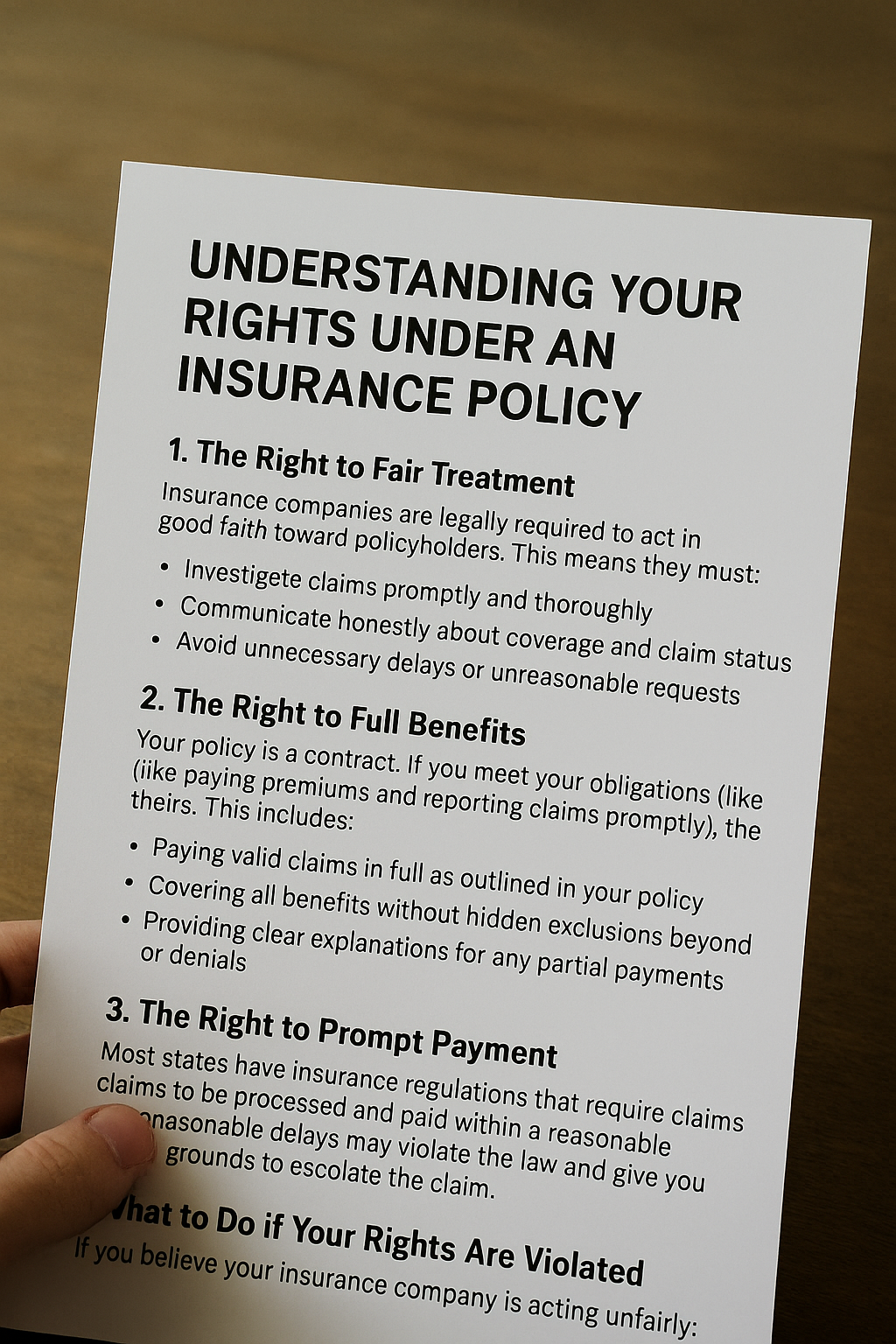

  • Understanding Your Rights Under an Insurance Policy

    Understanding Your Rights Under an Insurance Policy

    Insurance is meant to provide peace of mind. Whether it’s for your car, home, health, or life, a policy is a promise that if something goes wrong, your insurer will step in. But many policyholders don’t realize they have specific legal rights when it comes to filing a claim. Knowing these rights can protect you from delays, lowball offers, or unfair treatment.


    1. The Right to Fair Treatment

    Insurance companies are legally required to act in good faith toward their policyholders. This means they must:

    • Investigate claims promptly and thoroughly
    • Communicate honestly about coverage and claim status
    • Avoid unnecessary delays or unreasonable requests

    If an insurer deliberately stalls or denies your claim without cause, that could be considered bad faith insurance practices.


    2. The Right to Full Benefits

    Your policy is a contract. If you meet your obligations (like paying premiums and reporting claims promptly), the insurer must honor theirs. This includes:

    • Paying valid claims in full as outlined in your policy
    • Covering all benefits without hidden exclusions beyond what the policy states
    • Providing clear explanations for any partial payments or denials

    Tip: Always review your policy so you know exactly what is—and isn’t—covered.


    3. The Right to Prompt Payment

    Most states have insurance regulations that require claims to be processed and paid within a reasonable timeframe. Unreasonable delays may violate the law and give you grounds to escalate the claim.


    4. What to Do if Your Rights Are Violated

    If you believe your insurance company is acting unfairly:

    1. Document everything. Keep copies of emails, letters, and claim forms.
    2. Request written explanations. Ask for reasons behind any delay or denial.
    3. File a complaint. Contact your state’s department of insurance to report unfair practices.
    4. Seek legal help if necessary. An attorney can guide you if the insurer refuses to comply with the law.

    Bottom Line

    Understanding your rights under an insurance policy helps you hold companies accountable. A little knowledge can make the difference between a smooth claim and a frustrating battle.

  • Freedom to Protect: Independence & Legal Empowerment

    Freedom to Protect: Independence & Legal Empowerment

    Freedom to Protect: Independence & Legal Empowerment in Texas

    Imagine you are a business owner in Texas. You’ve worked tirelessly to build your business from the ground up, and you’re proud of what you’ve accomplished. But then, a dispute arises with a supplier, and you’re suddenly facing a potential lawsuit. You feel your independence slipping away as you grapple with the uncertainty of what might happen next.

    Now, imagine a different scenario. You’re still that business owner, but this time, you’ve taken proactive steps to protect your business. You’ve engaged in estate planning, you’ve made use of the Deceptive Trade Practices Act (DTPA), and you’ve secured solid contracts. When that dispute arises, you feel confident and empowered. You know your rights, you understand your legal protections, and you’re prepared to defend your business.

    This is the power of legal empowerment. It’s about using the law and legal tools to secure your independence and protect what matters most to you. In this blog post, we’ll explore the key legal instruments that can help individuals and business owners in Texas do just that.

    Estate Planning: Securing Your Future

    Estate planning is a crucial tool for protecting your independence. It allows you to decide how your assets will be distributed after your death, ensuring that your wishes are respected and your loved ones are taken care of. A comprehensive estate plan might include a will, a power of attorney, and a living will or healthcare directive.

    A power of attorney, for example, allows you to appoint someone you trust to make decisions on your behalf if you become incapacitated. This legal instrument provides peace of mind and ensures that your affairs will be handled according to your wishes, even if you’re unable to make decisions for yourself (Texas Estates Code §751.002).

    Consumer Protection: Knowing Your Rights

    The Texas Deceptive Trade Practices Act (DTPA) is another powerful tool for protecting your independence. This law provides protections for consumers against false, misleading, or deceptive business practices, unconscionable actions, and breaches of warranty (Texas Business and Commerce Code §17.46).

    Knowing your rights under the DTPA can empower you to take action if you’re the victim of a deceptive trade practice. For example, if a business misrepresents the quality or characteristics of a product or service, you may be entitled to damages, including mental anguish and attorney’s fees (Texas Business and Commerce Code §17.50).

    Insurance Litigation: Safeguarding Your Interests

    Insurance is a critical safeguard for both individuals and businesses. But sometimes, insurance companies don’t act in good faith. They may deny a valid claim, delay payment, or fail to defend a policyholder in a lawsuit.

    When this happens, insurance litigation can be a powerful tool for protecting your interests. Texas law provides remedies for policyholders who have been wronged by their insurance companies, including the recovery of attorney’s fees and interest on unpaid benefits (Texas Insurance Code §542.060).

    Civil Litigation: Enforcing Your Rights

    Finally, civil litigation is a key legal instrument for enforcing your rights and protecting your independence. Whether you’re involved in a contract dispute, a property dispute, or a personal injury case, civil litigation allows you to seek justice and hold others accountable for their actions.

    For example, if a supplier breaches a contract with your business, you can file a lawsuit to recover damages. Or, if you’re injured due to someone else’s negligence, you can sue for compensation. In both cases, civil litigation empowers you to stand up for your rights and seek the justice you deserve.

    Securing Your Independence Through Proactive Legal Action

    Legal empowerment is not just about reacting to legal challenges—it’s about being proactive. It’s about understanding your rights, knowing your legal protections, and taking steps to secure your independence before a dispute arises.

    Whether you’re an individual or a business owner, the legal tools discussed in this post can provide real independence and peace of mind. But to make the most of these tools, you need the right legal guidance. That’s where we come in.

    At Woodlands Law, we’re committed to empowering our clients through proactive legal action. We can help you understand your rights, navigate the complexities of Texas law, and take the necessary steps to protect your independence. Whether you need assistance with estate planning, consumer protection, insurance litigation, or civil litigation, our experienced attorneys are here to help.

    For a free consultation, call us at (832) 626-0116, visit woodlands.law, or schedule an appointment directly at https://woodlands.law/schedule.

  • When to Use a Business Attorney

    When to Use a Business Attorney

    Running a business is rewarding—but it also comes with legal risks and complex decisions. While many business owners try to do everything themselves to save money, the truth is having an experienced attorney on your side can prevent costly mistakes and even save you money in the long run.

    Here’s a guide to when you should call a business attorney—and why it’s worth the investment.


    1️⃣ Business Formation

    Starting your business the right way lays the foundation for future success.

    A business attorney can help you:
    ✅ Choose the right entity (LLC, corporation, partnership, etc.)
    ✅ File necessary paperwork correctly
    ✅ Draft an operating agreement or bylaws
    ✅ Understand tax implications and liability protections

    Cost vs. Benefit:
    An attorney’s fees are small compared to the costs of restructuring later or dealing with disputes over ownership or liability.


    2️⃣ Contracts and Agreements

    Clear, well-drafted contracts protect your business relationships and reduce risk.

    When to call an attorney:
    ✅ Drafting new contracts with customers, suppliers, partners, or employees
    ✅ Reviewing contracts you’re asked to sign
    ✅ Negotiating key deal terms
    ✅ Ensuring enforceability and compliance with local laws

    Cost vs. Benefit:
    A lawyer can help you avoid loopholes, hidden risks, and costly litigation down the line.


    3️⃣ Disputes and Litigation

    Even well-run businesses can face disputes.

    Call an attorney when:
    ✅ You’re threatened with a lawsuit
    ✅ A dispute arises with partners, employees, or vendors
    ✅ You need to enforce a contract
    ✅ You’re considering suing someone

    Cost vs. Benefit:
    Early legal advice often prevents lawsuits or positions you better if one happens.


    4️⃣ Regulatory Compliance

    Every industry has its own regulations. Ignoring them can lead to fines, penalties, and reputational damage.

    A business attorney can help with:
    ✅ Employment law compliance
    ✅ Industry-specific rules and licensing
    ✅ Data privacy laws
    ✅ Environmental regulations

    Cost vs. Benefit:
    Investing in compliance now avoids the expense and headache of government investigations or fines.


    5️⃣ Buying or Selling a Business

    Mergers, acquisitions, or even selling your business to a family member can be legally complex.

    A lawyer can:
    ✅ Conduct due diligence
    ✅ Draft purchase agreements
    ✅ Help with financing arrangements
    ✅ Ensure a smooth, legal transfer

    Cost vs. Benefit:
    Proper legal help protects you from liabilities and ensures you get fair value.


    6️⃣ General Counsel for Growing Businesses

    As your business grows, having a trusted legal advisor can pay off in many ways:
    ✔️ Proactive risk management
    ✔️ Faster contract turnarounds
    ✔️ Better negotiating leverage
    ✔️ Peace of mind knowing you’re protected


    📞 Ready to Talk?

    At The Woodlands Law Firm, we partner with businesses of all sizes to provide the legal guidance they need—when they need it.

    Contact us today for a consultation and find out how we can help your business stay protected, compliant, and ready for success.

  • Why Everyone Needs an Estate Plan

    Why Everyone Needs an Estate Plan

    When many people hear “estate planning,” they think it’s only for the wealthy. But the truth is everyone—no matter their income or assets—needs an estate plan.

    A good estate plan protects your family, honors your wishes, and saves your loved ones stress and expense down the road. Let’s look at why it matters and the basic tools that make it work.


    1️⃣ Plan for Incapacity

    Life is unpredictable. An illness or accident could leave you unable to make decisions about your finances or medical care.

    Without planning, your family may need to go to court for the authority to help you—costly, time-consuming, and stressful.

    Key tools:
    Durable Power of Attorney – lets someone you trust manage your finances if you can’t.
    Medical Power of Attorney / Healthcare Directive – appoints someone to make medical decisions on your behalf.


    2️⃣ Appoint Guardians for Minor Children

    If you have young children, your will is the place to name who you want to raise them if something happens to you.

    Without this, a court will decide—possibly choosing someone you wouldn’t have picked.

    ✅ A Will lets you choose guardians you trust and ensure your children’s well-being.


    3️⃣ Ensure Smooth Transfer of Assets

    When someone passes away without a plan, their estate may go through probate—a public, often slow court process.

    Estate planning helps your loved ones avoid unnecessary delays, costs, and conflict.

    Basic tools:
    Will – states who inherits what, and names an executor to carry out your wishes.
    Trust – can help avoid probate, keep things private, and manage complex needs like caring for minor children or loved ones with special needs.


    4️⃣ Protect Your Family and Your Wishes

    Estate planning isn’t just about money. It’s about peace of mind. It ensures:

    ✔️ Your wishes are legally enforceable.
    ✔️ Your family avoids confusion and conflict.
    ✔️ You make things easier during difficult times.


    5️⃣ It’s Not Just for the Wealthy

    No matter your age or income level, an estate plan is one of the most important gifts you can give your family. Even if you have modest assets, these documents can make all the difference.


    📞 Ready to Get Started?

    At The Woodlands Law Firm, we’re dedicated to helping families plan for the future with clarity and compassion.

    ✅ Wills
    ✅ Trusts
    ✅ Powers of Attorney
    ✅ Complete estate planning tailored to you

    Contact us today for a consultation and take the first step toward protecting what matters most.

  • What Can You Do If You’re Sued for the Wrong Reasons?

    What Can You Do If You’re Sued for the Wrong Reasons?

    Being served with a lawsuit is stressful—even more so when you believe the claims against you are unfair, baseless, or outright frivolous. But being sued doesn’t mean you automatically have to go to trial or pay up.

    Courts have procedures to weed out improper claims early. With the help of an experienced attorney, you can fight back quickly and effectively.

    Here’s what you need to know about challenging a bad lawsuit from the start.


    1️⃣ Understanding Frivolous or Baseless Lawsuits

    Not every claim brought against you has legal merit. Examples of improper suits include:

    ✅ Claims with no factual basis
    ✅ Lawsuits filed solely to harass or intimidate
    ✅ Legal theories that fail to state a claim recognized by law
    ✅ Suits filed in the wrong jurisdiction or venue

    Recognizing these flaws early is critical to mounting an effective defense.


    2️⃣ Early Defense Tools: Motion to Dismiss

    One of the most important early options is the motion to dismiss.

    ✅ A motion to dismiss asks the court to throw out the case before trial.
    ✅ It argues that even if all alleged facts are true, the plaintiff hasn’t stated a legal claim.
    ✅ Common grounds include lack of jurisdiction, improper venue, failure to state a claim, or expiration of the statute of limitations.

    Benefit: Saves time, money, and stress by ending meritless suits early.


    3️⃣ Affirmative Defenses

    Even if you can’t get a case dismissed outright, you may have affirmative defenses that defeat the claim.

    ✅ Statute of limitations has expired
    ✅ Plaintiff consented to your actions
    ✅ Self-defense or justification
    ✅ Plaintiff’s own negligence contributed to the harm

    Affirmative defenses must usually be raised early—often in your first answer to the complaint—or you might lose the right to use them later.


    4️⃣ Motion for Summary Judgment

    If a case survives the early stages, you can still try to end it before trial with a motion for summary judgment.

    ✅ Shows there are no genuine disputes of material fact.
    ✅ Demonstrates you’re entitled to judgment as a matter of law.

    Benefit: Avoids the time and expense of a trial when the facts and law clearly favor you.


    5️⃣ The Cost of Ignoring a Lawsuit

    Never ignore a lawsuit—even if you think it’s ridiculous.

    ✅ Failing to respond can lead to a default judgment against you.
    ✅ That judgment can be enforced through wage garnishment, liens, or bank account levies.

    Best practice: Always take legal action seriously and consult an attorney immediately.


    📞 Don’t Face a Lawsuit Alone

    At The Woodlands Law Firm, we help clients understand their options and fight back against unfair, harassing, or baseless lawsuits.

    ✅ We analyze the claims for weaknesses.
    ✅ We file motions to dismiss when possible.
    ✅ We assert all available defenses to protect you.

    Contact us today for a consultation. Let’s make sure you’re protected and prepared.